Poisoned SERPs in DataForSEO: why your rankings look wrong and how to fix it
Since late September 2026, Google has been serving some scrapers a fake results page: the layout looks normal, but most of the organic results are swapped for unrelated sites. DataForSEO calls these poisoned SERPs. If you track rankings, run audits or feed search results to an AI agent through DataForSEO, part of your data since then is wrong, and the API gave no error to warn you.
The fix is one parameter,
resolve_poisoned_results: true, released on November 16, 2026. It doubles the price of each task and fixes new requests only. Below: what poisoned results look like, how many there are, how to turn on the fix in the API and in SEO Utils, and what to do with the data you already stored.- What a poisoned SERP looks like
- How many results are poisoned
- Why Google does it
- How to spot poisoned results in your data
- Fix it in the DataForSEO API
- Fix it in SEO Utils
- Or switch providers
- Clean up the rankings you already stored
- Goto links: the other Google change
What a poisoned SERP looks like
DataForSEO counts a results page as poisoned when fewer than half of the sites that usually rank for the keyword appear anywhere on it. The page still has its ads, AI Overview and People Also Ask, so nothing looks broken at a glance.
Here's "best running shoes" in Austin, Texas, on November 18, 2026, from a test by Phuc Le, maker of the rank tracker SEO Utils:
| # | Poisoned result | Real Google result |
|---|---|---|
| 1 | bennysjolind.com | runrepeat.com |
| 2 | usahomeserve.com | runnersworld.com |
| 3 | letsrun.com | reddit.com |
| 4 | modernman.com | sixminutemile.com |
| 5 | us.headtopics.com | nike.com |
Poisoned pages also erase brands from their own name. Ilias Ism, who builds the SEO tools LinkDR and AI SEO Tracker, searched his own name: real Google showed his site, LinkedIn and X profile. The poisoned page showed a random Instagram post, a blog page from 2012 and scrambled X posts.
Google doesn't block the scraper with a
429 Too Many Requests error. It answers 200 OK with the wrong results, so retries, alerts and error logs never fire.How many results are poisoned
The numbers depend on the keywords, the location and the day, but all of them are big:
- 20-30% of all scraped results since September 26, by DataForSEO's CTO's estimate, in the company's first post on the problem (October 23, 2026). Google has served fewer poisoned pages since October 10, but the share never reached zero.
- 34.7% of 19,309 stored SERPs after September 20, against 0.37% before it, an 87x jump, in Ilias Ism's audit of his own database.
- About 70% of normal fetches looked poisoned in Phuc Le's test on November 18.
Ilias also checked the same keywords across 5 SERP APIs. The share of clean results:
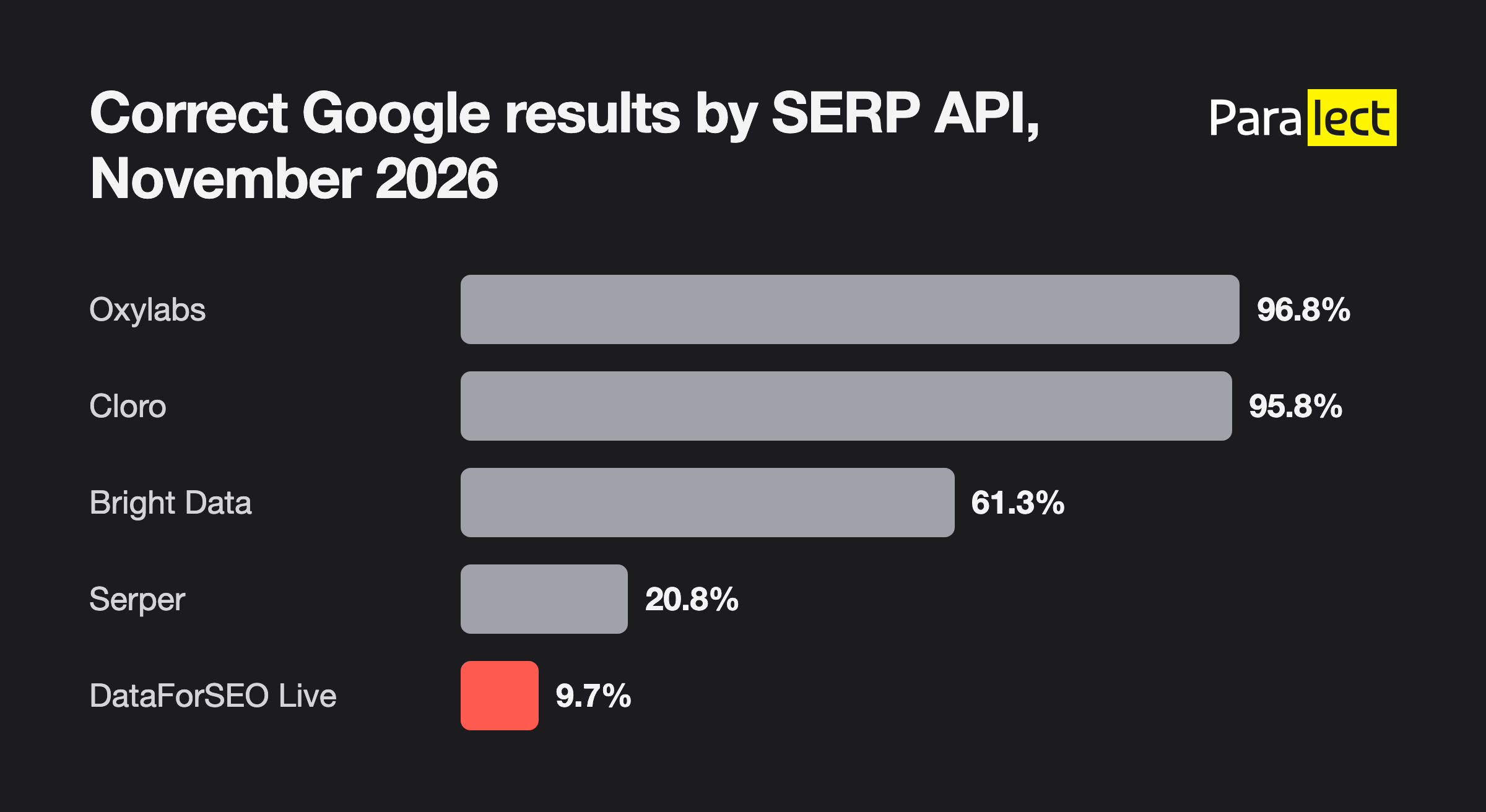
The DataForSEO number is without the fix, which shipped the same day. Every provider that scrapes Google gets poisoned pages; the ones at the top filter them better.
Why Google does it
Google hasn't said. DataForSEO links it to Google's fight with scrapers: SearchGuard in January 2025, the end of the
num=100 parameter, and the google.com/goto redirect links in August 2026. Poisoning started around the time of Google's September 2026 spam update, but it kept going after the update finished rolling out on October 8, so the update alone doesn't explain it.Our guess at the reason: a fake page with a
200 OK works better against scrapers than a block. A blocked scraper knows it was caught and changes IPs. A poisoned one keeps collecting bad data.How to spot poisoned results in your data
Ilias Ism runs 4 checks before his agents read a results page. Any one of them flags the page:
Usual sites are gone
2 or fewer of the 10 domains that usually rank are on the page
The #1 site is missing
The site that held #1 is nowhere on page 1
Names don't match
3 or more site names on 1 social handle or domain
Results miss the query
None of the top 3 results match the search
When a check fails, he falls back to the last clean snapshot for that keyword.
Other signs in a rank tracker:
- Many keywords drop on the same day and come back the next. Real ranking changes don't move 40% of your keywords at once.
- Your brand isn't #1 for your brand name.
- The ranking URL is a site you've never heard of for a keyword you've tracked for months.
To check one result by hand, open the
check_url from the API response in an incognito window and compare.Fix it in the DataForSEO API
Add
resolve_poisoned_results: true to each task:JSON
Loading editor...
POST https://api.dataforseo.com/v3/serp/google/organic/task_post
[
  {
    "keyword": "best rank tracking tool 2026",
    "location_code": 2840,
    "language_code": "en",
    "resolve_poisoned_results": true
  }
]
How it works, from DataForSEO's announcement:
- DataForSEO fetches the normal results page.
- It fetches the same search in Google's Web tab, which shows plain links only.
- It compares the organic results of the 2 pages.
- If they match, you get the normal page back unchanged.
- If they differ a lot, the organic results are replaced with the Web tab's, and each restored result carries
"checks": ["from_web"]. AI Overviews, People Also Ask and ads stay as fetched.
What to know before you turn it on:
- It works in Standard and Live, desktop and mobile, JSON and HTML.
- You pay for the extra page on every task, poisoned or not:
| Task | Without the fix | With the fix |
|---|---|---|
| Standard, normal priority | $0.0006 | $0.0012 |
| Standard, high priority | $0.0012 | $0.0024 |
| Live | $0.002 | $0.004 |
- It's off by default. Set it on every request that matters.
- It returns an error with
udm=weborudm=14inurlorsearch_param. Those already ask for the Web tab.
- It fixes organic results only. If you track AI Overview citations or People Also Ask, those can still be wrong.
- It doesn't fix data you already stored.
- It works as long as Google leaves the Web tab alone. If Google starts poisoning that tab too, the fix stops working.
Use it for rank tracking, where one bad day goes into the history and sets off false alerts, and for anything an AI agent reads. For one-off keyword research, a poisoned page now and then matters less, and you can skip the extra cost.
Fix it in SEO Utils
In SEO Utils, go to Organic Rank Tracker → edit your tracker → SERP Collection and turn on Let DataForSEO fix poisoned results. It's off by default and adds $0.0006 per keyword ($0.0012 on high priority).
Phuc Le compared the fix against Cloro, another SERP API, on the same keywords, city and day, and checked each page against a manual Google search:
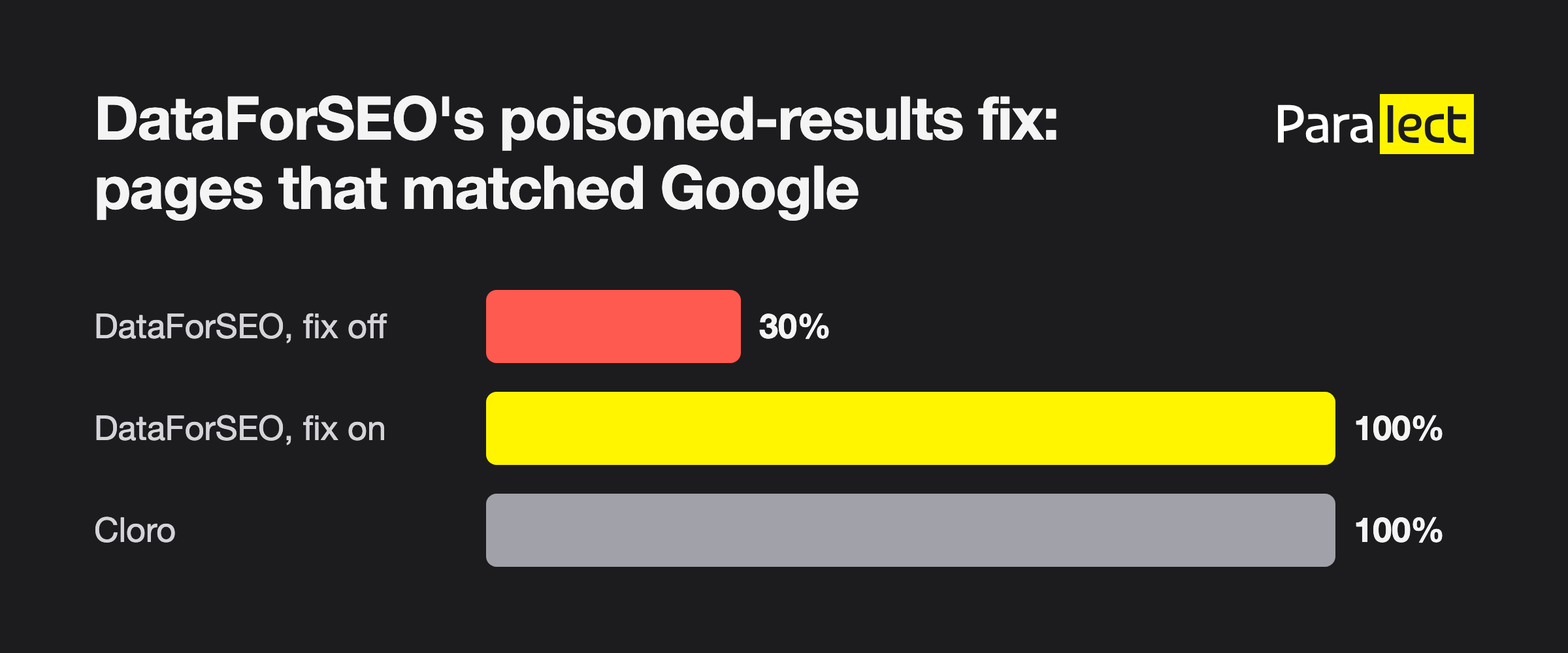
With the fix on, 96% of the top-10 sites matched Cloro's and 78% sat at the same position. "Matched" here means the page kept at least half the sites a manual search showed; exact positions differ between any 2 fetches, even on real Google.
In his first test, the pages that still looked wrong with the fix on were local searches sent without a city. Each fetch landed in a different town. Set a location on every local keyword.
Or switch providers
Ilias Ism fixed it by moving to another SERP API. In his test, Oxylabs and Cloro returned clean pages about 96% of the time. Before you switch:
- Run your own keywords through 2 providers for a week and compare with the 4 checks above. 1 person's test on 1 set of keywords doesn't tell you how your keywords will do.
- Compare the price per 1,000 keywords with the fix on. DataForSEO with the fix costs $1.20 per 1,000 standard tasks.
- Keep 2 providers wired in. Google changes how it treats scrapers every few weeks. A second source lets you switch in a day.
Clean up the rankings you already stored
The fix doesn't reach back, so the data from late September to mid-October needs a decision:
- Mark the period in your reports. DataForSEO suggests annotating everything from September 20 on. The worst of it ran from about September 26 to mid-October.
- Run the 4 checks on stored snapshots and flag or delete the ones that fail. Don't average poisoned days into monthly positions.
- Use Search Console for your own site. Its average position comes from Google's own data and isn't affected. DataForSEO's advice: export Search Console data for this period now, before it ages out of the 16-month window.
- Don't act on a 1-day drop. Wait for 2-3 clean runs before you report a ranking loss to a client or rewrite a page.
- Re-check AI agent outputs from that period. Content briefs, competitor lists and keyword clusters built from poisoned pages point at the wrong competitors.
Goto links: the other Google change
At the end of August 2026, Google started wrapping result links in
google.com/goto redirects, so the API returned Google's redirect instead of the site's URL. At the end of October, Google also limited how fast those links resolve from 1 results page. In one EverGrow study, 58.7% of organic results came back as goto links on October 30. EverGrow saw none from November 6 on.If your data still has
google.com/goto URLs, set resolve_goto_urls: true. It's on by default for normal-priority Standard tasks and off for Live and high priority, where it adds at least 40 seconds per request. For links you already stored, DataForSEO's free goto_url_converter endpoint converts up to 100 at a time.⚠️
Checklist: turn on
resolve_poisoned_results for rank tracking, set a location on every local keyword, mark September 20 to mid-October in your reports, use Search Console as the truth for your own site, and keep a second SERP provider ready.Ship faster than
your competition
Focus on customers and sales while we handle product delivery. Hire a dedicated AI maker or a whole product team.
Launch new products
Fix your delivery
Hit fundraising milestones
[Analytics Chart]
Wireframe v0.1
Sarah Chen CEO, Founder
$127k
MRR
2,847
Customers
+23%
Growth
Sales Performance
Latest Deal
Enterprise plan closed
Acme Corp · $12k/mo


Services
Industries
Hire
Claude Code Devs Next.js DevsReact DevsReact Native DevsSupabase DevsLovable DevsAI EngineersFull-stack Devs Upwork Alternative
AI Tools
Resources
Kickstart No-Code Stack Tech Stack Tech Trends AI SaaS Skills MCP Servers Academy Help Center Blog Changelog
Our products


© 2026 Paralect, Inc 651 N Broad St, Suite 206, Middletown, 19709, Delaware, United States